
Who Owns the Learning?
The sovereign AI debate is asking the wrong question.
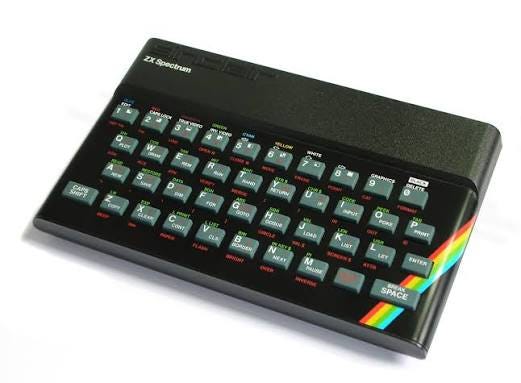
Back in ancient times, when I was writing programs in Sinclair BASIC, the machine knew nothing. Everything it did, I had to teach it. When I wrote a scheduling program for the home helps at my dad’s work, the Spectrum could not improve what it did without me.
The most significant development in Westminster this week is the appointment of Kanishka Narayan as the first AI minister to attend Cabinet. I’m so pleased. It matters because there isn’t enough money to do all the things Andy wants as PM, unless the public sector makes significant productivity gains fast, and the only route to that is AI.
Done right, more people will be scheduled for surgery and outpatient appointments, courts will deal with cases more quickly and policing will be more effective. Labour can win the next general election on the back of it. Kanishka is not just the AI minister. He’s the single most important delivery minister in Andy’s cabinet.
Sadiq Khan entered the AI debate this week too. The London mayor’s AI and Jobs Taskforce, chaired by Martha Lane Fox, busted the jobs apocalypse myth. AI, it found, changes the nature of work, improving decision making and giving greater agency to those who use it.
This challenges the usual debate about “sovereign AI”, which several ministers seem to think means national ownership of the stack: Britain owning the chips, the data centres, the pipes and the models.
What unites AI evangelists and the tech doomsayers is the assumption that the coming general intelligence will be extraordinary. And I know this is heresy in certain circles, but what if general intelligence turns out to be just mediocre, or rather, just average?
Back in the early 90s, when I had decided to change the world rather than read computer science, I struggled through the introduction to political thinkers module in my first year at Hull University. John Locke and Alexis de Tocqueville were both on the list. Tocqueville crossed America in 1831 to look at the prison system and gleaned a bigger danger. He found: “A middling standard is fixed in America for human knowledge. All approach as near to it as they can; some as they rise, others as they descend.” He was nearly two hundred years ahead of himself when it comes to general artificial intelligence.


Alexis de Tocqueville and John Locke
A general model is trained on everything we have ever written. It drags us to a consensus, the average of us, the middling standard fixed by machine. And that standard is high, make no mistake; the machine’s average would beat most of us on most days. A study in Science Advances two years ago (Doshi and Hauser) found that generative AI makes individual writers more creative and their collective output more alike. (NB I use AI all the time to enhance my writing, and though it reads better, it makes me feel, well, just a little less feisty as a polemicist)
I’m not saying the models aren’t brilliant. I love them. This barely matters strategically though, because they’re brilliant for everyone all the time, provided you pay for it in monthly tokens. For a company, that means zero competitive advantage; your competitor gets the same brilliance for the same tokens.
There are two brains in this argument. The general one, which anyone can rent. The particular one, which only an institution can build.
Tocqueville chimed a second warning, against mild despotism and “an immense and tutelary power”. He asked: “What remains, but to spare them all the care of thinking and all the trouble of living?” Swap the paternal state for the rented superbrain from OpenAI or Anthropic, and aren’t we in the same position? I won’t hazard a guess at how many FTSE 250 companies are pouring their IP into large language models, but I bet it’s more than half. Our danger isn’t that the machine can’t think well enough. It’s that it spares us the care of thinking. An institution that rents its mind grows mediocre even when the mind is exceptionally gifted.
A decade ago in the Guardian I called automation “the most urgent issue facing the country”. At the time, George Osborne envisaged driverless lorries on our roads. A decade later, they’re not here. The only driverless vehicle I’ve seen was a taxi going the wrong way on a west London road earlier this year. I asked how the robots’ wealth and time would be shared with displaced workers whose labour was taken. Maybe I was only half right. The machines have not just come for the labour. They are taking the institutional learning.
Back in the day, when I was at the Cabinet Office, I set up the Power of Information Taskforce to release as much government generated data into the public domain as we could. People started doing inventive things, like overlaying public transport travel times on maps to see how long it would take to commute from a new flat.
As a country, it feels like we have been arguing about who owns the data ever since. The better question, it turns out, is a couple of centuries older. Who owns the learning?
Locke, if I remember my first year correctly, has a lesson for us. Property, he argues in the Second Treatise, begins when we mix labour with the world. Today, property is made when a nurse schedules a day of consultations in a hospital, and an engineer teaches a model what a failing bearing sounds like. Human endeavour mixed with a model’s output creates new understanding, and it belongs to the institution that did the work.
So here’s what I think sovereign AI ought to mean, and it isn’t a Union Jack flying over a data centre. Call it cognitive sovereignty. Use the best intelligence in the world, wherever it comes from, and keep the learning it creates under British control.
An interest to declare: I sit on Palantir UK’s public policy committee, so discount what follows accordingly. I’m not a technologist or a data lawyer. I’m the bloke who wrote the home help scheduler, forty years on.
The company’s conviction that an institution should own its own data and ontology runs deep. The persistent myth, that Palantir somehow wants to privatise Britain’s medical records, doesn’t survive the paperwork: NHS England remains the data controller, and Palantir processes data only under NHS instruction. The intelligence can come from anywhere. The learning stays where the work is done. Somewhere in the NHS today, a scheduler is relieving someone of pain by connecting them to a clinician, and this time the machine can learn from them. What is learnt, the collective wisdom of the front line, becomes a permanent public asset, for you, for us, the proud owners of the NHS.
Across the economy, a manufacturer should keep its engineers’ knowledge, and the AI model it trains, within the company; a bank its staff’s financial judgement; a government department the business processes crafted between smart civil servants and a model owned by HMG.
The worst thing a new minister used to hear, and I have, is: “Minister, you are responsible for a government IT project.” Senior managers used to treat technology as something to buy and hand down to passive employees. Give it instead to the people who understand the problems and let them build, adapt and improve the systems they use. The worker not an appendage of the machine, the machine expanding the worker’s capacity to act. That is my vision of a nation’s sovereign AI.
The test for ministers is not whether an AI system cuts costs, though it should, but whether it leaves an institution more capable: does it improve the judgement of the people using it, capture what they learn, keep the knowledge under the institution’s roof, let the people closest to the problem shape the system? With billions going to start-ups, compute capacity and specialist talent, it will be wasted if hospitals, courts and police stations stay passive renters of intelligence created elsewhere.
My fear is this. If Kanishka cannot persuade the nation to adopt AI in a way that retains the wisdom of workers, the workers will use the tools anyway, and the learning will end up owned by Anthropic or OpenAI. Tocqueville feared democracy would settle for the middling standard. We cannot let Britain accept this. We need cognitive sovereignty, not just our own data centres.
Use the best intelligence available. Strengthen the people doing the work. Own the learning, the wisdom.
Good luck, Kanishka. You have the biggest job in government.
As an early adopter of the Becta scheme for teachers back in the day I cannot but agree with you. Most staff I worked with were very reluctant to include technology in their teaching. Only when they saw how the tech could enhance their teaching, their use of time and even their relationships with the children did they, slowly, start to integrate it into their teaching. It made an enormous difference and got them to examine and change practice as well as, and in my opinion most importantly, to share and develop the things that really worked.
AI as a tool is invaluable and the learning it can enable is at the core of how it can improve lives.
My only fear is that politicians will be reactive and behind the game rather than steering and owning the game.
Great piece Tom. This jumped out ‘Our danger isn’t that the machine can’t think well enough. It’s that it spares us the care of thinking. An institution that rents its mind grows mediocre even when the mind is exceptionally gifted.’
If we outsource our daily thinking or creativity to ai, we can achieve 80% good enough. And for many tasks that’s, well, good enough. But when everyone can do 80% good enough, it’s our institutional talent and memory that takes us into the top 5%.