
The wrong Andrew
the accidental creation of authority at the despatch box
It finally happened.
I am so out of touch that I have become a stereotype. A political cliché. A fully signed-up member of the House of Lords, blinking at the television and asking, quietly, who on earth is that man.
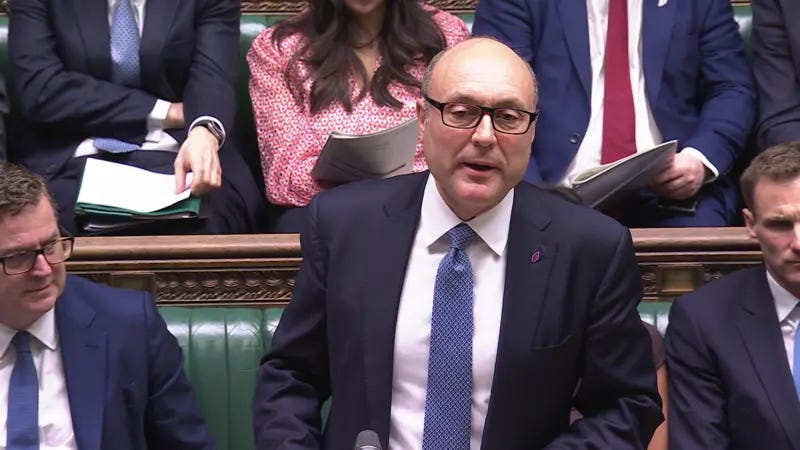
There he was at PMQs, standing in for Kemi Badenoch, and I had no idea who he was. Never met him. Never noticed him. I did what any modern parliamentarian does when faced with ignorance. I Googled him.
I Googled Andrew Griffiths MP.
This was a mistake.
For a moment I wondered whether the Conservative Party had made a bold and unexpected commitment to rehabilitation. Then it dawned on me.
I had Googled the wrong Andrew.
I should have Googled Andrew Griffith MP. Without the s.
Let us be thankful for small mercies.
Incidentally, to my mild surprise, the former Tory MP Andrew Griffiths, with the s, does not yet appear to have been clutched to the bosom of Nigel Farage. This may simply be an administrative delay. One assumes the paperwork is under way.
And my God, what a CV. Former finance director of Sky. The sort of CV the owner would have printed off, framed and hung on the wall of his parliamentary office. “A great chairman and shareholder,” he once said of Rupert Murdoch, praising his habit of urging colleagues to “think bigger, bolder or better”, showing early signs there of a great speech-making statesman, deploying alliteration and a tidy little tricolon in a single sentence.
At the despatch box he told the House he had spent 25 years building and running businesses. Professor Google later confirmed that the pinnacle of this journey was becoming the interim chairman of Just Eat. Which, in my former life, made him a towering figure. There was a period when the fruits of his strategic leadership, his vision for the home delivery demographic, arrived at my door in paper bags.
So here he was, Andrew Griffith MP, the correct Andrew, sent out to take on David Lammy.
I should say at this point that David did well. More than well. He was calm, fluent and visibly in command of the form. He understood the rhythms. He knew when to answer and when to glide past. He looked like a man who knew that PMQs is not an exchange of information but a test of nerve and presence. He did not overreach. He did not wobble. He stood his ground and let the other side tire itself out. Which, to be honest, was a surprise.
Andrew Griffith, by contrast, was a study in careful professionalism. He pointed constantly, but never quite at anything. His finger would shoot out first, in a vaguely chosen direction, and then his eyes would follow, as if awaiting instructions. Marionette energy.
He did the “Andy from Manchester” gag. He really did it. You could see the moment he expected it to land, and the slightly longer moment when it didn’t. At that point his body seemed to change shape, as if all the strings had suddenly been cut. Crestfallen. Like a man opening a Just Eat tray after the pub only to realise they have delivered the wrong order.
This, I think, was meant to be the moment. All those years of business interventions had led here. During his 25 years everything had been measured, segmented, leveraged and addressed. Nothing, inconveniently, had been persuaded. He was all delivery and no destination which, given that he was the former interim chairman of Just Eat, you might have thought he would have spotted the problem.
It was boardroom English, carefully imported into the Commons. The sort of language designed to reassure people who already agree with you while gently anaesthetising everyone else.
Lammy listened. He nodded. He also shook his head, slowly, as if filing something away for later. He replied with ease. Standing opposite him, doing the basic things well, he began to look expansive. Not because he was grandstanding, but because someone else had chosen not to. Competence, in that context, starts to resemble authority.
By the end, I found myself wondering whether Mr Griffith knew the price of a chicken tikka on the Just Eat app, Mr Speaker. Or whether that knowledge, like so much else, had been delegated.
In the end, Andrew Griffith achieved something few people set out to do, and almost nobody manages by accident. Armed with management speak, professional confidence and a tie knotted with what looked like industrial-grade hairspray, he performed a small and entirely unplanned political feat.
He did not win the argument.
He did not shift the mood.
He did not create a moment.
But standing there, saying nothing memorable and doing nothing wrong, he changed the weather.
The former interim chairman of Just Eat ended the afternoon looking very much like the former interim stand-in for Kemi Badenoch. One assumes this was not in his KPIs.
Across the despatch box, David began to look like John F. Kennedy. Not because he suddenly soared or promised a new frontier, but because he stood upright, spoke in whole sentences and appeared to know exactly where he was. The tie stayed put. The answers arrived on time. The room, briefly, paid attention.
And sometimes, in modern politics, that is all it takes.
Andrew Griffith did not make history that afternoon. But he did make someone else look like they might.
Which, in its own quiet way, may yet stand as his greatest achievement.