
The first hit was Thatcher
Prime ministerial removals, the media beast and parliament
The first full-scale removal of a Prime Minister as a national media spectacle was Margaret Thatcher in 1990. I remember it well. The members of Hull University Labour Club drank a heroic amount of lager in the John McCarthy Bar that day, watching history unfold. I remember one Tory student crying. It left me feeling slightly guilty for being euphoric.
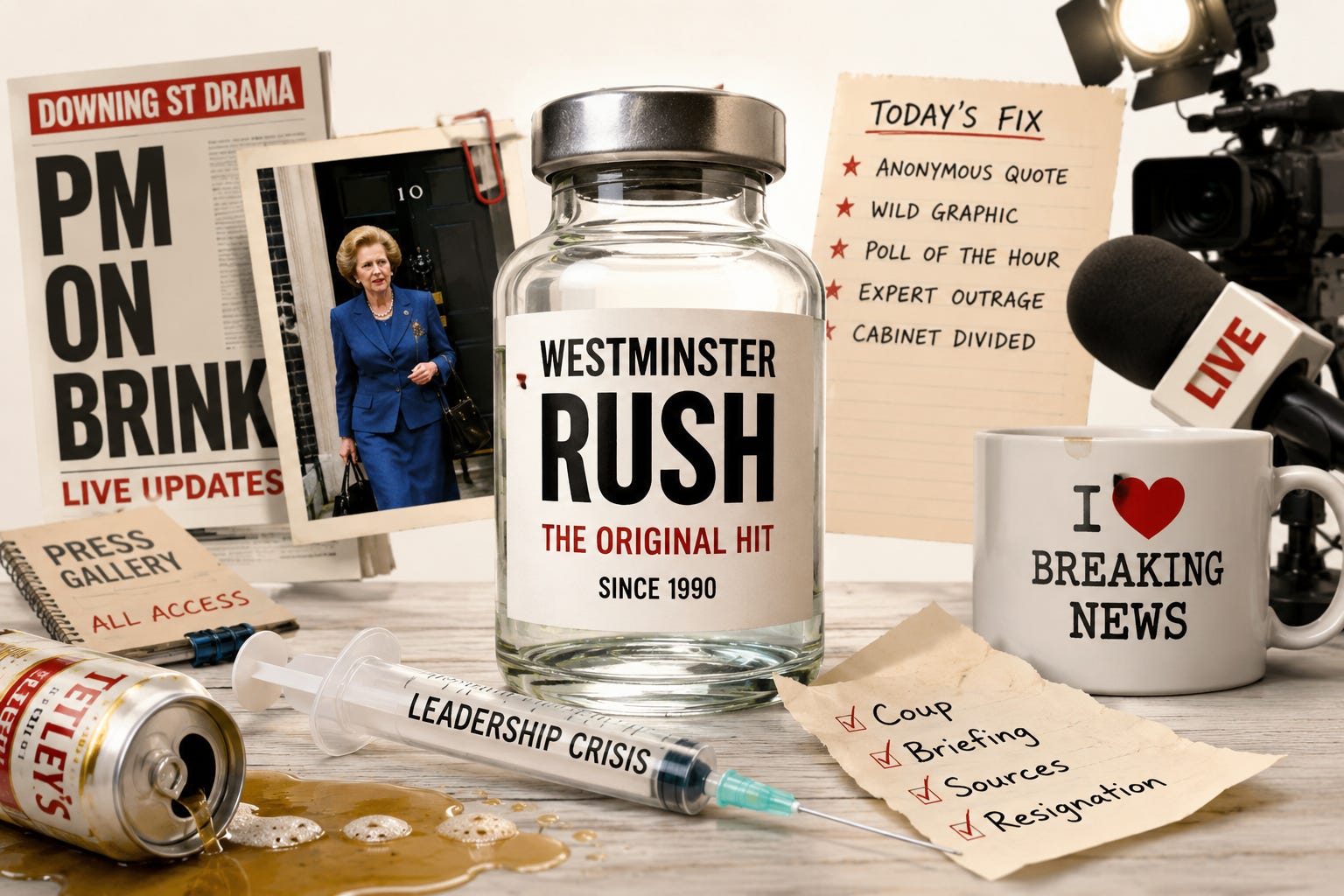
It was cruel, obviously. But it was also mesmeric television. This was before I’m a Celebrity, before Who Wants to Be a Millionaire, before the nation learned to process emotional collapse by voting for someone to eat a kangaroo’s private parts.
I once asked a seasoned lobby journalist why they became so obsessed with prime ministerial scalpings. He replied, with the calm authority of a man describing a wine list in a Soho restaurant “We all got a taste of it in 1990 and we’ve been chasing the high ever since.”
This was before Twitter and TikTok, before the narcotic little reward system of social media made television look like a Church of England jumble sale, before every political rumour came with its own mini film crew, graphics package and man from a polling company pretending not to enjoy himself.
These days it’s much worse.
Lobby journalists like to post social media clips of themselves outside Number 10, standing there in the rain as though democracy is a hostage situation and only their boom mic can catch the sound of machine gun fire inside Number 10.
Five hundred years ago, political journalists would have been the ones nearest the gallows at a Whitehall hanging, not out of cruelty, you understand, but they needed to make sure there was no pulse.
Churchill, Attlee and even Wilson would not have lasted ten minutes in the digital age. Churchill would have survived Hitler only to be destroyed by a breakfast clip involving Pol Roger and a dressing gown. Attlee would have been written off after a podcast appearance on ‘The Westminster Meat Grinder” in which he answered every question in five words and refused to describe his “leadership journey”. Wilson would have been finished by a TikTok explaining the pound in your pocket, while a producer shouted, “Great, but can we make devaluation more relatable to a younger demographic?”
You can hear the tremor in journalists’ voices whenever a Prime Minister starts to wobble. Nick Robinson’s voice climbed two semitones this week, and accelerated into that special Today programme register reserved for wars, resignations and arrests
The House of Commons isn’t much better
In a crisis, Parliament moves onto MP time. MP time is not like normal time. Normal time has hours, lunch and perhaps a walk after tea. MP time is lived in minutes. Each minute contains a factoid, a WhatsApp, three rumours, a lobby journalist asking whether you are “hearing anything” and someone you barely know texting, “Where’s so and so?” as though the Labour Party is missing a child in a supermarket.
Everyone gets involved because not being involved is the same as political death. If you are not in a WhatsApp group, you may as well be in a crypt. If you have not been asked to sign a letter, you are the undead. If you have not been quoted anonymously, even inaccurately, you begin to wonder whether you still exist.
When there is no new development, the lobby, fuelled by adrenaline, sleep deprivation and Pret coffee, starts to go a bit mad. Speculation hardens into analysis. Analysis curdles into “mood”. Mood becomes another graphic. The graphic foretells a constitutional crisis. MPs then feed this machine because they, too, need the little dopamine pellet of seeing their own unattributed thought appear on the Twitter account of someone from Sky News.
I know this because I have been there. I have fed the beast. I have been the beast’s sous-chef. I have diced the onions of intrigue and plated up the garnish of doom. Watching it now is anxiety-inducing.
This week I have developed a quiet respect for the roughly 150 Labour MPs who have spent the last 72 hours doing precisely nothing. They have not resigned. They have not been promoted. They have not signed a letter demanding something, opposing something or urging a “process” towards something. They have put their heads down and done their jobs, an act so eccentric in modern politics it may soon require its own sub-genre in undergraduate political science classes.
Naturally, this will irritate everyone who has done something. The activists of the coup, counter-coup, pre-coup, soft-coup, non-coup and vibes-based-coup cannot understand why their colleagues refuse to perform. “Why won’t they move?” they ask, like disappointed generals watching a battalion of squares remain seated.
And to every MP who has stayed off broadcast media, well done. If there were an award for remaining calm under fire, I would give it to you. Not at a ceremony, obviously. That would attract cameras and then you would have to go on Politics Live to explain why you accepted it.
I have taken more interest than I should in the minute-by-minute tribulations of the poor Prime Minister this week. Most of it has been wall-to-wall hyperbole, of course. But one comment deserves to be placed in a glass case, lit from beneath and studied by future historians of political self-harm.
One Labour MP said on Times Radio that bond markets “will have to fall into line” with Andy Burnham’s policy agenda.
Hahahaha.
No, really.
Hahahaha.
The bond markets, those notoriously obedient institutions, just waiting for a Labour MP to tell them to stop mucking about and behave. Somewhere in the City, a bond trader heard this, cancelled his Bloomberg terminal subscription and said, “Fair enough, a Labour MP has spoken. Pack it up, lads. Democratic socialism has priced the gilt curve.”
To all those campaign managers out there, if there is a campaign, and I am not saying there is, do not let anyone offering this argument within fifty feet of it. Not near the manifesto. Not near the launch. Not near the biscuits. Certainly not near a microphone. Put them in charge of something harmless, like the commemorative tote bags, and even then check the exchange rate.
And if a Treasury spad is reading this, I know there are not as many as there once were, please send everyone Paul Mason’s article on bond markets. Or, at the very least, a YouTube explainer called Why Money Sometimes Leaves The Country When Politicians Frighten It.
It’s only Wednesday and I’m exhausted. The beast is still being fed. And somewhere, deep inside the lobby psyche, 1990 is still playing. Thatcher walking out. Cameras flashing. Reporters’ hearts kicking against their ribs. Lager being spilled in Hull. The first hit. The original rush.
They have been chasing it ever since.
Incisive, funny and very true.
Marvellous - completely on the money!