
Denton snowflake?
A man who believes speech is over-policed confirms his theory by reporting some
The Matthew Goodwin snowflake row began with a tweet and ended, as these things often do, with an angry man explaining himself.
In these early days of the Gorton and Denton by-election, Labour circulated a short social media clip featuring remarks by Matthew Goodwin, Reform UK’s candidate. In it, Goodwin said he had been “unfortunate enough” to be in Manchester. Labour’s caption suggested this was an odd way to introduce yourself to voters in the North.
Goodwin objected. Reform UK complained to Greater Manchester Police, arguing the post breached election law by misleading voters. The police reviewed the complaint and decided no offence had been committed.
Labour did not retreat. It called him a snowflake.
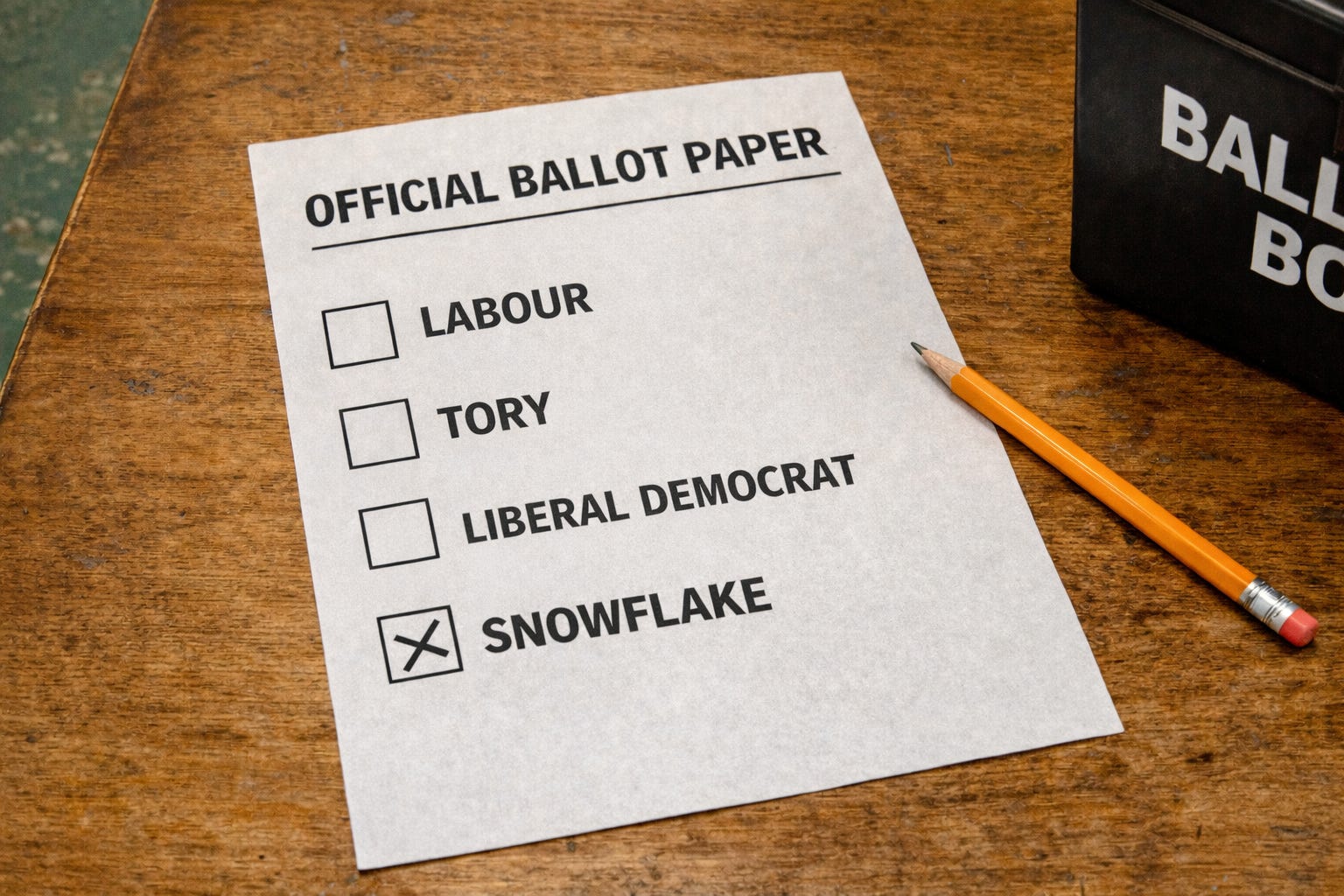
Goodwin replied that he was not a snowflake but was “sick of Labour lies” and acting on principle to defend democratic standards. The clip slipped from view. The denial became the story. The row was complete.
Ordinarily this would have been a forgettable campaign skirmish, were it not for the complication that Goodwin is not just another candidate. He is an author with a theory.
In Values, Voice and Virtue, he argues that British politics is dominated by a liberal, metropolitan “new elite” which controls institutions and narrows the range of acceptable opinion. Dissenting voices, he claims, are marginalised not by argument but by authority. Brexit, in this telling, was the backlash.
It is a serious claim. Which is why the by-election moment mattered.
Faced with a mildly mocking tweet, the man who warns that speech is over-policed did not respond with humour, rebuttal or indifference. He escalated it to the police. The theorist of silencing called the cops.
It does not bode especially well for the by-election journey. As John Crace writes in The Guardian, this has already begun to resemble “an idiot’s guide to running a byelection campaign.”
Crace notes that the campaign launched with a photo opportunity outside “the Stanley hotel”, which “just happens to be in Angela Rayner’s constituency”, adding that Lee Anderson “could happily have spent the next four weeks knocking on the wrong doors.” When the error of launching a campaign in the wrong seat was pointed out, Lee Anderson “quickly tweeted that the photo he had posted clearly showed he was in the right place. Go figure.”
Local knowledge, in other words, has not been the campaign’s strong suit. As Crace observes, Reform ended up announcing a candidate who had “retreated to London to be a media gobshite for GB News” before inviting the country to “Step forward, Matt Goodwin.”
In that context, reporting a tweet to the police looks less like an isolated lapse and more like pattern. A campaign that cannot admit to standing in the wrong place is unlikely to take mockery, correction or laughter in its stride.
Calling Goodwin a snowflake was bait. Would he ignore it, laugh it off or do the one thing guaranteed to keep the story alive.
He did the one thing.
He denied it.
He explained it.
He insisted he was not offended.
Reviewers of Values, Voice and Virtue have already noted that the book is hazy about who exactly counts as an “new elite”, thin on evidence that those with real economic power share a single outlook and oddly uninterested in the issues voters say matter most, the cost of living, the NHS and housing.
A by-election is an unforgiving place for abstraction.
Campaigns are not seminars. They are loud, mocking and occasionally unfair. They reward thick skin and punish hyperbole. Faced with a joke at his expense, Goodwin acted as though mockery itself were a criminal offence.
Matthew Goodwin may not be a snowflake. Let us grant him that.
But he has revealed himself as a thin-skinned candidate and a tetchy professor, discovering too late that politics does not make exceptions.
Academia is a peer-reviewed environment. A by-election, it turns out, is one too, only the reviews come in faster and nobody lets you revise the draft.
Brilliant takedown of the performative contrarianism here. That irony of writing a whole book about speech policing then literally filing a police complaint over banter is almost too perfect. In local politics, I've notced the loudest "anti-cancel culture" voices are usualy first to demand someone get fired over a joke. The real tell is escalating instead of just posting through it like everyone else does.
I got another email from the Labour party yesterday, asking me to "chip in" some cash to help defeat Goodwin.
They wouldn't have needed to ask me if they hadn't blocked Burnham from standing, would they?
Its frustrating to have got to this point.
My membership hangs by a thread.